Breast milk donors’ motivation and experiences with donation and use of medicines
Summary
Background: Breast milk is uniquely suited to meet infants’ nutritional needs and is particularly important for premature infants. When a mother’s own milk is not available, donor milk from milk banks can be an important alternative. Potential breast milk donors must undergo a thorough assessment of both their health and their use of medicines, as recipients of donor milk are vulnerable. All use of medicines and herbal products during the donation period must be declared, and both chronic and occasional use can lead to exclusion. Knowledge about Norwegian donors’ experiences and the management and assessment of medicine use is limited.
Objective: The objective of the study was to explore breast milk donors’ motivation and experiences with breast milk donation, as well as to map their use of medicines, dietary supplements and natural remedies during the donation period. We also sought insight into how breast milk donors assess and manage such use during the donation period.
Method: The study has a qualitative design and is based on semi-structured, individual in-depth interviews. The interviews were transcribed and analysed using systematic text condensation. In total, 15 breast milk donors at Oslo University Hospital were interviewed during the period January–February 2025.
Results: Breast milk donors were motivated by both altruistic and pragmatic factors and described the donation as meaningful, though at times it was time-consuming and a practical challenge. The most common dietary supplements were vitamin D, multivitamins, omega-3 and iron. Two of the donors reported using herbal products during the donation period, through dietary supplements and herbal tea, respectively. The use of mild analgesics, such as paracetamol and ibuprofen, as well as vaccines and nasal sprays, was common among the donors. Nevertheless, the donors demonstrated considerable caution with regard to medicines. Several chose to modify, delay or avoid use altogether, even when the medicines were compatible with breast milk donation.
Conclusion: The breast milk donors were largely motivated by altruism, and the donation process was described as moderately challenging. The study shows that donors used dietary supplements during the breastfeeding period to maintain their own health and help ensure the quality of their milk, and used medicines when necessary in accordance with applicable guidelines for breast milk donation. Their approach to medicine use was characterised by a strong sense of responsibility for recipients’ safety, involving careful risk assessments and a high degree of restraint.
Cite the article
Bazaz S, Grøvslien A, Nordeng H. Breast milk donors’ motivation and experiences with donation and use of medicines. Sykepleien Forskning. 2026;21(104727):e-104727. DOI: 10.4220/Sykepleienf.2026.104727en
Introduction
Breast milk is a unique, biologically adapted source of nutrition that promotes growth and development in infants and young children (1, 2). It is particularly important for sick and premature infants, who often face specific health challenges and require close monitoring (3). When mothers are unable to provide their own milk, donor milk from milk banks can serve as a valuable alternative.
Norway has 12 milk banks and these are affiliated with the neonatal intensive care units of the country’s largest hospitals. The milk banks collect milk from voluntary donors and distribute it to premature and sick infants throughout the country (4). To ensure the safety of recipients, women wishing to donate breast milk must undergo a thorough assessment of their health, lifestyle and medicine use before they can become donors (4).
Stricter requirements regarding medicine use are imposed on breast milk donors than on nursing mothers in general, because premature infants are less able to metabolise medicines and are therefore at higher risk of adverse effects (5, 6). Donors are therefore required to declare all use of medicines and natural remedies, both before and during the donation period, as both chronic and occasional use may render them unsuitable as donors (4).
Breast milk donation is voluntary and unpaid (4). Personal motivation is therefore crucial in the decision to donate. International studies show that the motivation is primarily altruistic, linked to a desire to help others and contribute to something meaningful (7–9).
However, an international review from 2025 indicates that inadequate support and limited facilitation by the health service can create uncertainty and reduce motivation (9). Despite several international studies, knowledge on the motivations and experiences of donors in Norway remains limited, highlighting the need for research in a national context.
Medicine use in breast milk donation is also an under-researched topic, both nationally and internationally. International studies show that nursing mothers in general exercise caution with medicine use (10, 11). However, little is known about how breast milk donors assess and manage medicine use during the donation period. More knowledge is needed in this area to ensure safe, responsible and evidence-based donation practices.
In this context, medicines are defined as substances that can be used to prevent, relieve, treat or diagnose disease in humans (12). Dietary supplements are defined as products that supplement the normal diet (13), while natural remedies are plant-, animal- or mineral-based products that are not approved as medicines (14).
Objective of the study
The objective of the study was to explore the motivations and experiences of breast milk donors at Oslo University Hospital’s milk bank, with particular emphasis on their use and management of medicines, dietary supplements and natural remedies during the donation period. To this end, we sought to address the following research questions:
- What motivates women to donate breast milk, and what are their experiences with the donation process at Oslo University Hospital’s milk bank?
- How do breast milk donors manage their use of medicines, dietary supplements and natural remedies during the donation period?
Method
The study has a qualitative design and involved semi-structured interviews.
Recruitment
The breast milk donors were recruited through purposive sampling in collaboration with Oslo University Hospital’s milk bank. Women who had donated breast milk to this milk bank in 2024 or 2025 were informed about the study and invited to participate via email by the head of the milk bank, who is the second author.
Those who wished to participate were then sent an information sheet and a consent form. For ethical reasons, potential donors who had lost a child were not approached in order to avoid causing them unnecessary distress.
Data collection
A semi-structured interview guide was used to collect data from 15 study participants. We developed the guide together with the study’s user representative, who had personal experience as a breast milk donor in 2024. The guide was devised in a systematic process and was pilot-tested twice with the user representative to ensure clarity, relevance and user-centredness. It covered topics such as: 1) motivation and experiences related to donation, 2) use of dietary supplements, natural remedies and medicines, and 3) attitudes and considerations regarding medicine use during the donation period.
The interviews were audio-recorded using the University of Oslo’s dictaphone app ‘Nettskjema-diktafon’ to ensure secure recording (15). The interviews were conducted remotely via Zoom, except for one, which was conducted in person. Interviews were held remotely due to the geographical distances and time constraints of the breast milk donors. The first author conducted all interviews.
The first author transcribed the recordings on the same day as the interview or the day after. The audio recordings were automatically transcribed verbatim using NB Whisper (16). The automatic transcription was then carefully reviewed, anonymised and corrected to ensure accuracy and confidentiality, in accordance with Malterud (17).
Data analysis
The transcribed data were analysed using systematic text condensation, as described by Malterud. The analysis consisted of four steps (17) (Figure 1).
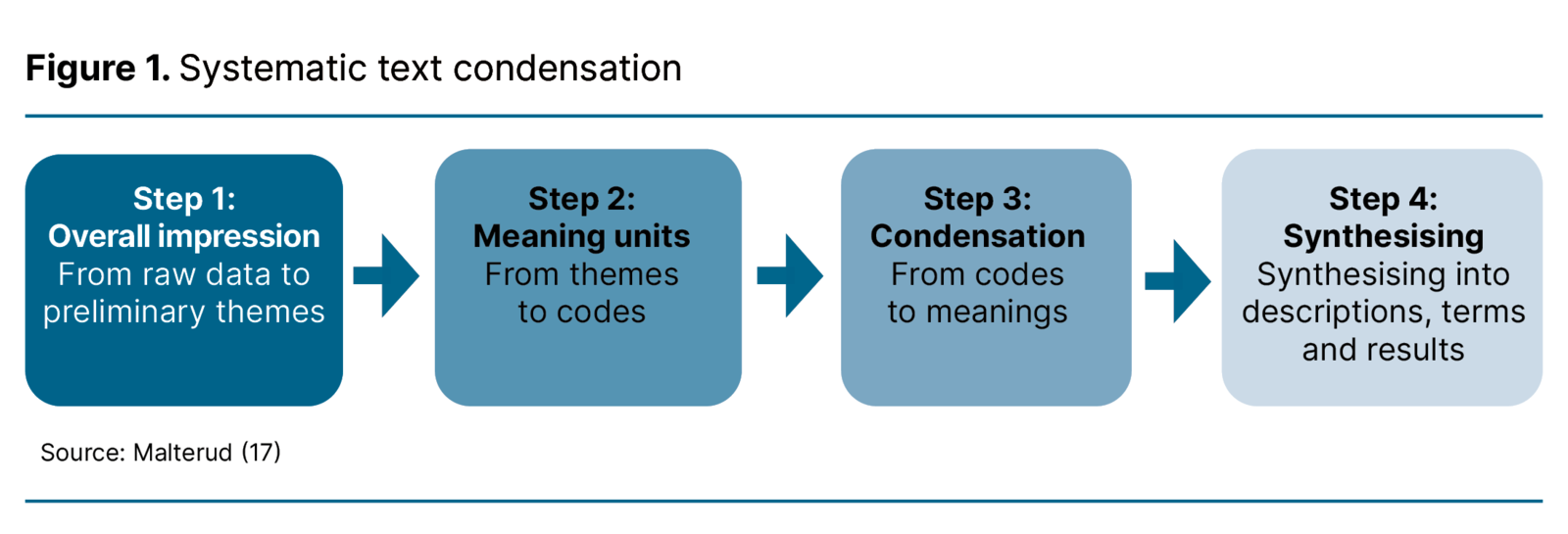
In the first step, we formed an overall impression by reading through the data twice, while noting preliminary themes. In the second step, text that was relevant to the preliminary themes and research questions was identified and colour-coded. In the third step, we abstracted meanings from the meaning units and sorted them into subcategories.
For each subcategory, we developed a condensate. In the final step, the condensates were transformed into an analytical text, which formed the basis for the results. Table 1 presents extracts from the analysis.

Ethical considerations
The study was approved by the data protection officer at Oslo University Hospital (case number 24/23840), reported to Sikt – the Norwegian Agency for Shared Services in Education and Research (reference number 672172), and assessed as falling outside the mandate of the Regional Committees for Medical and Health Research Ethics (REK) (application number 860459).
The safety and privacy of the breast milk donors were safeguarded in accordance with the University of Oslo’s research ethics guidelines (18). Written consent to participate was obtained before the interviews, and all personal data and audio recordings were treated confidentially and stored securely. It was not possible to link the transcribed data to specific breast milk donors.
Results
We interviewed a total of 15 breast milk donors in January and February 2025. Seven of the women were active donors at the time of the interviews, while the remaining eight had donated milk within the past year. The average age of the women was 33.4 years and the average donation period was 5.7 months.
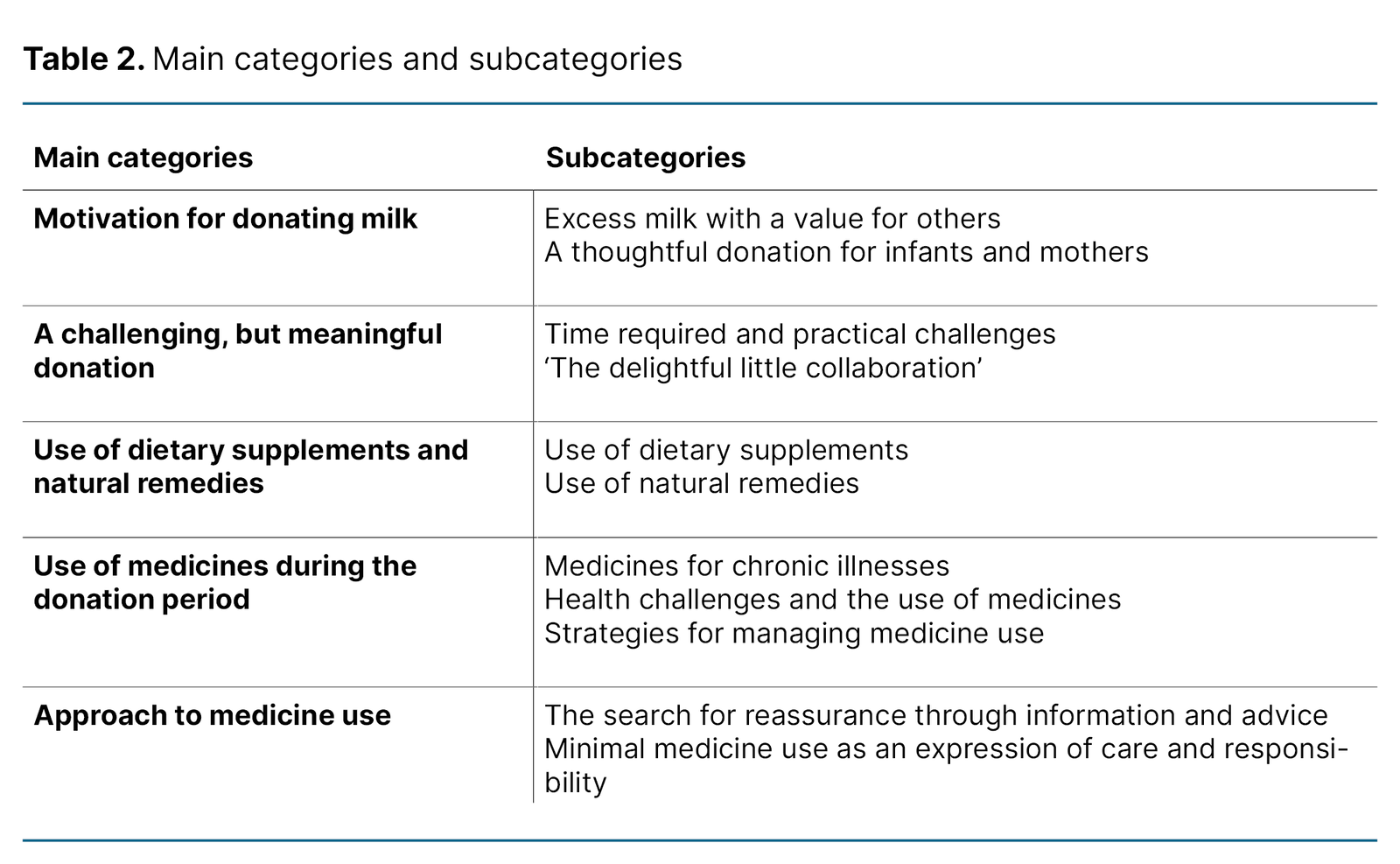
The interviews totalled 512 minutes and comprised 124 pages of transcribed text. The data analysis resulted in five main categories with corresponding subcategories (Table 2.
Motivation for donating milk
The breast milk donors reported that their excess milk was an important motivation for donation. Several of the donors did not want to waste their excess milk and saw donation as a meaningful way to help ‘those who have a tougher start in life’.
Many expressed concern for the burden on the parents of premature and vulnerable infants. It felt natural to pass their excess milk on. One donor, referred to as ‘MD’ in the quotes, expressed it as follows:
‘My motivation was to be able to provide milk for those with premature babies, so the baby could get a good start in life, so the mother has time to start producing her own milk without having to think too much about it.’ MD15.
For others, the motivation to donate was linked to positive experiences with the health service and healthcare personnel, which triggered feelings of gratitude and a desire to give back:
‘I felt very safe and well cared for during childbirth, so I kind of wanted to give something back and show my appreciation for what they had done for me.’ MD10
A challenging, but meaningful donation
Breast milk donation was described as challenging but meaningful. The hygiene procedures and delivery were highlighted as particularly time-consuming, and some described the procedures as ‘a hassle’ and ‘extra work’. Both the distance to the facility and the time required were considered barriers.
Many, however, found that donation became less challenging once they had established a good routine. Several eased the stress of delivery by accumulating their expressed milk and making fewer deliveries. One donor explained:
‘I usually let my expressed milk accumulate, because we live on the other side of the city, and it takes a while to get to the hospital […], so I end up bringing larger batches rather than making frequent trips.’ MD5
Despite the challenges, the breast milk donors were grateful for the support and flexibility of the milk bank staff. Several described the donation programme as both low-threshold and trust-based. When asked whether donation had been challenging, one donor replied:
‘Eh no, because it’s set up so that there’s no pressure. I don’t have to deliver during periods when I can’t.’ MD5
Use of dietary supplements and natural remedies
The majority of the donors used dietary supplements during the breastfeeding and donation period. The most common supplements were vitamin D, multivitamins, cod liver oil or omega-3, and iron. One donor used a multivitamin that also contained herbs.
Use of supplements among the breast milk donors varied. Some took supplements regularly as part of their own health routine, while others used them to meet specific needs related to breastfeeding and donation. Supplement use was often based on the donors’ own assessment of needs, breastfeeding recommendations, dietary habits or advice from healthcare personnel and the milk bank:
‘The milk bank said that vitamin D is very important, so I took it and made sure to take vitamin D and cod liver oil capsules while I was donating milk.’ MD10
Two donors did not use dietary supplements during the donation period and expressed some reluctance. One highlighted in particular that she was unsure what was safe to take and found it easier to abstain, because “then you know you’re good”.’:
‘There’s the fact that there isn’t a list telling you what you can or can’t take, and then it’s easier not to take anything.’ MD5
Use of natural remedies was uncommon among the donors, and several were sceptical to this. Some reported drinking tea with chamomile, lemon or ginger, but explained that this was not for medical reasons. Only one donor described using herbal tea during the donation period, emphasising that use was limited and based on careful considerations of safety:
‘I’ve only drunk teas that are well known […] I’ve checked almost everything I’ve put in my mouth 50 times over. I’ve been very selective and have stuck to three types: Greek mountain tea, peppermint tea and lactation tea.’ MD11
Use of medicines during the donation period
Two breast milk donors used medicine for chronic conditions. One took Levaxin and insulin for hypothyroidism and type 1 diabetes, respectively, while the other used a progestin-only pill for endometriosis. A third donor used Ventoline for asthma, but only as needed. The women described the approval process as ‘thorough but uncomplicated’.
Several of the breast milk donors experienced various health issues during the donation period, leading to sporadic and as-needed use of medicines. The most common were paracetamol, ibuprofen, vaccines and decongestant nasal sprays (Table 3).
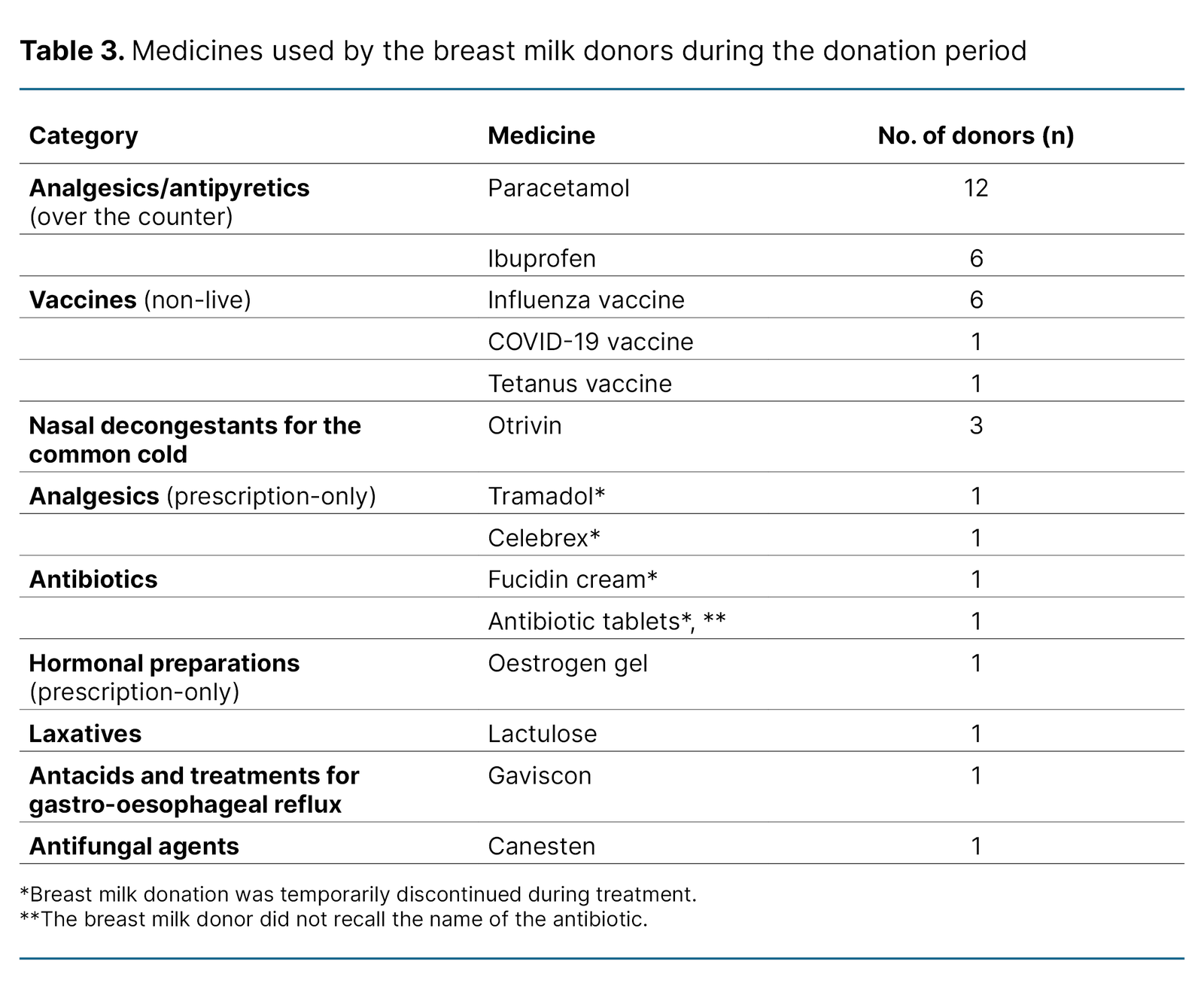
Breastfeeding-related discomfort, headaches and symptoms of infection were the most common health issues that led to the breast milk donors taking medicines. Minor ailments were often managed with non-pharmacological measures such as rest, fluid intake, breast massage and more frequent breastfeeding, whereas more severe problems necessitated the use of medicines.
The majority described medicine as a last resort when other measures did not provide sufficient relief:
‘I can have quite a lot of headaches and don’t always reach for paracetamol just because it’s an easy solution, but perhaps I’m being extra cautious now because I’m breastfeeding and donating milk […] I try to avoid it, and instead I drink water, go for a walk, or try to sleep.’ MD4
Among the donors who used medicine, the most common course of action was to temporarily stop donating milk. Several described their milk as ‘spoiled’, and the decision to temporarily stop donating was often based on moral and ethical considerations regarding potential risk to recipients. Many, however, continued to breastfeed their own infants when they were ill and using medicine, reasoning that their child ‘has been through everything already, so it’s fine to use whatever is needed’:
‘I stopped donating milk when I had Ibux in my system. I took Ibux one evening, and then I didn’t use the milk I expressed the following morning.’ MD12
Some donors developed their own routines to reduce the concentration of medicine in their breast milk by timing expression around medicine consumption. Others followed the milk bank’s guidelines and labelled the milk when medication had been used:
‘I tried to maximise the time between expressing milk and taking painkillers, or stick to a minimum interval, i.e. expressing at roughly the same time, just before the medicine enters the bloodstream, and I labelled all of my expressed milk with “Paracetamol”.’ MD11
Some donors were not always aware that certain products they used – often locally acting medicines and vaccines – were considered medicines. One donor reflected that this was probably overlooked because people often ‘treat tablets a bit differently to other medications’.
Approach to medicine use
The breast milk donors were aware that medicines could affect the quality of their milk. Many expressed a need for information and sought advice from various sources, including RELIS (a national network in Norway providing information on medicines), Trygg Mammamedisin (a public service in Norway that gives advice about medicines), healthcare personnel and the milk bank. The Norwegian Pharmaceutical Product Compendium (Felleskatalogen) and patient information leaflets were also cited as useful sources of information.
Unclear or conflicting advice from their general practitioner (GP) and other sources caused uncertainty regarding medicine use for some of the women, leading to them making their own assessments about use during breastfeeding. This led to two donors postponing treatment or temporarily discontinuing breastfeeding:
‘I ended up stopping because I didn’t feel comfortable with it, especially since he wasn’t very familiar with oestrogen treatment, so I thought I’d just wait until we finished breastfeeding.’ MD8
Several donors found that other healthcare personnel were more accessible and helpful regarding questions about breastfeeding and medicine use. One donor said that her GP provided little tailored guidance:
‘It doesn’t help me much when it just says I should speak to the doctor, and he then reads out what’s written in the patient information leaflet […] so I contacted the health visitor and the breastfeeding support service, and they were more specific.’ MD1
The breast milk donors described being cautious and conservative with medicine use during the donation period, primarily to ensure the milk was safe for recipients. One donor explained that the information she received from the milk bank about the recipients’ vulnerability made a strong impression on her and made her more conscientious about her own medicine use:
‘I tried to do everything else before taking painkillers, and being a donor definitely made me more motivated. You know that once your child is older it’s completely safe to take painkillers, but when they’re premature, I was even more motivated to try everything else first.’ MD11
For some, breast milk donation meant they had to avoid certain medicines in order to continue donating. One donor explained that she chose not to take cetirizine because it was incompatible with milk donation:
‘I didn’t take those allergy pills at all, so I just had to go around with an itchy mouth and itchy eyes. But I thought it was worth it – I didn’t want to risk making these babies any sleepier.’ MD7
Discussion
Motivation and experiences
The findings of our study show that breast milk donors are motivated both by a desire for a pragmatic solution for excess milk and by a wish to help others. This finding aligns with two Swedish studies by Blomqvist and Olsson (19, 20) as well as other international studies (7–9), all of which highlight practical and altruistic motives. The women in our study also expressed strong concern for the recipients’ families and described donation as a way of supporting families in a vulnerable and stressful life situation.
Furthermore, our findings suggest that positive experiences, along with support and gratitude to the health service and healthcare personnel increase the motivation to donate breast milk. This is consistent with a review by Mahdikhani et al. (9), which shows that support from healthcare personnel can be crucial for donors’ motivation. These findings suggest that healthcare personnel who work with postpartum women and nursing mothers play a key role in fostering positive donor experiences and supporting recruitment to milk banks.
The donation process was considered challenging at times. Our findings and several international studies (8, 19, 20) show that hygiene procedures and milk delivery are among the most challenging aspects of donation. Since breast milk donation is voluntary and unpaid (4), it is important to identify the barriers donors encounter.
A British cross-sectional study from 2025 indicates that logistical barriers can reduce donor motivation (21). Nevertheless, the breast milk donors in our study were able to overcome these barriers. Many expressed gratitude for the milk bank’s support and flexibility, which enabled them to establish their own routines and better manage the donation process.
A study by Candelaria et al. (22) found that support and guidance from nurses were crucial for breast milk donors’ motivation. This finding highlights the importance of supportive healthcare personnel and flexible donation arrangements that can be tailored to individual needs, promoting more accessible and low-threshold donation practices.
Use of dietary supplements, natural remedies and medicines
The majority of the donors used at least one dietary supplement during the donation period, which is consistent with international studies showing widespread use of supplements among nursing mothers (11, 23, 24). Two donors expressed uncertainty regarding their use, in line with findings from a Turkish study indicating that nursing mothers are sceptical about whether it is safe to use dietary supplements (24).
Among the donors in our study, the use of herbal medicines was low, with only two reporting such use. However, international studies from Turkey (24), Australia (25) and Italy (26) show that nursing mothers make considerably greater use of herbal medicines. In a national study from 2011, 37.3 per cent of women reported having used herbal medicines during a previous breastfeeding period (27), suggesting that natural remedies are widespread among nursing mothers more generally.
Although use of herbal products was limited, it did occur. This suggests that some donors may not have regarded herbal products in the same way as medicines. It may therefore be useful to emphasise that the guidelines also apply to herbal and natural remedies (4).
A lack of clear and consistent guidelines on the use of herbal remedies and dietary supplements can lead to uncertainty and unintended use. This demonstrates the need for clear guidance to ensure safe practice and reduce the risk of misunderstandings or differing interpretations. Our findings also indicate that healthcare personnel who meet donors can play a key role in advising them and referring them to the applicable guidelines for breast milk donation.
A recurring principle among the donors was ‘as few medicines as possible’, which is consistent with the findings of the systematic review by Spiesser-Robelet et al. (10). The review shows that nursing mothers avoid using medicines in order to protect their infant from unnecessary exposure (10). This is reflected in our findings, where donors describe a sense of responsibility towards the recipients. They therefore carry out careful risk assessments to ensure recipients’ safety and regard the use of medicines as a last resort.
The medicines used by the breast milk donors in our study were in accordance with Norwegian guidelines (4). Although use largely fell within the guidelines (4), several adjusted the timing of doses or temporarily paused donation as a precautionary measure. This finding is consistent with international evidence showing that nursing mothers are often cautious about using medicines, even when such use is compatible with breastfeeding (10, 11).
One of the breast milk donors in our study refrained from using cetirizine for allergies as it was not compatible with donating milk. According to current Norwegian guidelines, only local allergy preparations are permitted, whereas international guidelines, such as British (28) and Italian recommendations (29), allow the use of non-sedating antihistamines such as cetirizine. Although the use of medicines among donors is limited, it is important that guidelines are regularly updated so that they reflect new evidence and align with international practice.
Strengths and limitations of the study
One of the strengths of the study is its qualitative approach, which allowed for flexible and nuanced conversations. It was also a strength that we adopted a conscious reflexive stance, actively considering our role and preunderstandings throughout the research process. The use of pilot interviews, continuous transcription and adjustments to the interview guide helped improve the quality of data, while the involvement of a user representative ensured thematic relevance and close alignment with users’ perspectives.
Digital tools were used to conduct the interviews. An advantage of remote interviews is increased geographical accessibility and flexibility for participants (30), particularly in the context of a busy everyday life. However, the remote format entailed a methodological limitation, as it reduced the opportunity to interpret non-verbal cues and to build rapport with participants.
Limited interviewing experience, technical challenges and interruptions during the process may have negatively affected the data collection. The mapping of medicines, dietary supplements and natural remedies was based on self-reporting, which requires both accurate recall and honest reporting. Some participants may have had difficulty remembering what medications they had used, or their names or doses, potentially reducing data accuracy (31).
Furthermore, recruiting from a single milk bank limits the study’s generalisability, as the findings may be influenced by local routines, practices and information provision, which may not be representative of other milk banks, either nationally or internationally.
Conclusion
This study is the first in a Norwegian context to qualitatively explore breast milk donors’ motivations, experiences and medicine use. Donors at Oslo University Hospital described both practical and altruistic motives, at the core of which was a desire to use their excess milk to help vulnerable infants and their parents. They found it meaningful to donate milk, but it was also challenging at times, particularly in relation to hygiene and milk delivery.
The use of dietary supplements was common, particularly vitamin D, omega-3, multivitamins and iron, while natural remedies were less common. Donors were conscientious about their medicine use and approached it responsibly. They mainly used mild painkillers such as ibuprofen and paracetamol, vaccines and decongestant nasal sprays. All use was in accordance with current guidelines.
The findings indicate a need for flexible and individually tailored donation systems that can lower barriers to participation and promote more inclusive milk bank practices. They also emphasise the importance of regularly updating guidelines for breast milk donation, particularly in relation to dietary supplements, natural remedies and medicines, to ensure alignment with current evidence and international practices.
The study provides healthcare personnel in neonatal units, postnatal care and milk banks with valuable knowledge about breast milk donation, which can inform the guidance and follow-up offered as well as donor recruitment.
Acknowledgements
We would like to extend our thanks to the breast milk donors at Oslo University Hospital for their input in interviews. We would also like to thank the study’s user representative, Karoline Steffensen, for her valuable input in the development of the interview guide.
The authors declare no conflicts of interest.
Open access CC BY 4.0
The Study's Contribution of New Knowledge


Comments