Experiences of intensive care nurses following a trauma nursing course
Summary
Background: Worldwide, trauma-related injuries are a leading cause of death in people under the age of 45. Intensive care nurses play a central role in the management of trauma-related injuries, which requires specialised competence in trauma nursing. KITS2 is an advanced trauma nursing course designed to enhance the competence of intensive care nurses who care for trauma patients in ICUs and high-dependency units, as part of the effort to improve and assure the quality of treatment.
Objective: To explore intensive care nurses’ experiences of caring for trauma patients in ICUs and high-dependency units following completion of the KITS2 course.
Method: A qualitative, exploratory design was used. Thirteen intensive care nurses from ICUs and high-dependency units at a trauma centre and an acute hospital with trauma care facilities participated in a total of three focus groups. The data were analysed using systematic text condensation.
Results: The findings indicate that KITS2 strengthened intensive care nurses’ observational skills and improved their ability to identify symptoms of complications at different stages of the course of treatment. Interdisciplinary collaboration became more clearly defined in terms of roles and responsibilities, and intensive care nurses developed greater awareness of their own role within the treatment team. The course material was subsequently used as a knowledge resource in clinical practice.
Conclusion: This is the first Norwegian study to examine intensive care nurses’ experiences of caring for trauma patients in ICUs and high-dependency units after completing the KITS2 course. The study demonstrates that KITS2 provides valuable knowledge that increases intensive care nurses’ confidence in managing trauma patients, strengthens their understanding of interdisciplinary collaboration, and serves as a knowledge resource in clinical practice. Intensive care nurses play a key role in the management of trauma patients. Their role should therefore be emphasised in national guidelines.
Cite the article
Dahl K, Eriksson U, Andersen-Hollekim T. Experiences of intensive care nurses following a trauma nursing course. Sykepleien Forskning. 2026;21(104754):e-104754. DOI: 10.4220/Sykepleienf.2026.104754en
Introduction
Worldwide, trauma-related injuries are a leading cause of death in people under the age of 45 (1). Trauma refers to a physical injury resulting from an accident or single act of violence that causes damage to tissues and organs (2).
Trauma care in Norway is formalised and outlined in the National Trauma Plan (3). This formalisation is intended to ensure appropriate care in all components of the trauma pathway: prevention, first aid at the scene of injury, trauma admission, treatment in the hospital setting and rehabilitation.
Two different hospital levels provide care for trauma patients: trauma centres and acute hospitals with trauma care facilities. There are four trauma centres in Norway; one in each regional health authority. Trauma centres are required to meet the standards set for acute hospitals with trauma care facilities in accordance with the National Trauma Plan. In addition, clinical requirements for trauma centres have been defined in line with those of other Western countries (3).
A standardised and systematic approach is central to all trauma care (4). Injuries are diagnosed and managed concurrently according to the ABCDE protocol: Airways, Breathing, Circulation, Disability and Exposure (2) (Table 1).


Trauma patients are received in the emergency department by an interprofessional trauma team consisting of doctors, nurses/specialist nurses and a radiographer (3).
The trauma team first performs a primary survey to identify and address immediate threats to life. This is followed by a secondary survey consisting of a head-to-toe examination to detect injuries that may have implications for further treatment, including rehabilitation. When patients are admitted to an intensive care or high-dependency unit, a structured handover is conducted based on the ABCDE protocol (5).
Six hours after the primary survey, the trauma team leader (a surgeon) performs a new head-to-toe examination known as the tertiary survey (3).
Intensive care nurses play a key role in the management of trauma patients in the hospital setting (6, 7). Their responsibilities include stabilising and maintaining vital functions, preventing complications, monitoring the patient and initiating appropriate interventions (4).
The Department of Traumatology at Oslo University Hospital, Ullevål, has developed two trauma nursing courses (KITS1 and KITS2), with the aim of improving and assuring the quality of trauma care (8). KITS1 is a mandatory foundation course for nurses, specialist nurses and radiographers who work in trauma teams. The course covers key topics in trauma care and includes practical skills stations for hands-on training (9).
KITS2 is an advanced course for nurses and intensive care nurses working in ICUs and high-dependency units (6, 8). The learning methods employed in the course are case-based reflection groups and introductory lectures (6, 8). The course addresses topics such as admission to ICUs and high-dependency units, the body’s physiological response to trauma, associated injuries and complications (Table 2).

Prior to the course, participants receive a compendium containing organ-specific chapters and a link to Oslo University Hospital’s trauma patient manual (6).
Intensive care nurses’ experiences with trauma care is an under-researched area. Existing studies primarily focus on experiences in prehospital settings and the emergency department (10–12). Intensive care nurses consider trauma patients to be more resource-intensive and challenging than other intensive care patients because of the complexity of injuries, unpredictable outcomes and involvement of multiple professional groups (13, 14).
Trauma nursing courses enhance nurses’ knowledge and make them more confident in caring for trauma patients (10–12). Clinical experience is also important, and experienced nurses have both the experiential knowledge and practical skills that enable them to manage this patient group (13).
Several studies, however, highlight the importance of ongoing education to maintain clinical competence through both theory and practice (10, 11, 15–17). A Norwegian quantitative study of multidisciplinary healthcare personnel found that trauma nursing courses with active, participant-centred learning methods improved participants’ practical skills and made them feel more confident in their abilities (12).
There is a lack of qualitative studies exploring intensive care nurses’ experiences of caring for trauma patients in ICUs and high-dependency units after completing trauma nursing courses. Intensive care nurses’ experiences can provide valuable insight into how they manage complex patient situations after taking trauma nursing courses. Their experiences can also help inform the development of targeted educational initiatives in acute and intensive care medicine.
Objective of the study
The objective of this study was to explore intensive care nurses’ experiences of caring for trauma patients in ICUs and high-dependency units after completing the KITS2 advanced course.
The study addressed the following research question: ‘What are intensive care nurses’ experiences of caring for trauma patients in ICUs and high-dependency units after completing KITS2?’
Method
Design
The study employed a qualitative, exploratory design (18, 19). Data were collected through focus groups (20) with intensive care nurses. The COREQ checklist was used for reporting qualitative research.
Sample and recruitment
A purposive sampling strategy was employed to select participants best suited to addressing the research question (18). The study’s inclusion criteria were intensive care nurses working in ICUs and high-dependency units who had completed KITS2. Table 3 presents the composition of study participants.
Contact details for potential participants were obtained following an enquiry to the KITS2 course coordinator at the Department of Traumatology, Oslo University Hospital. A total of 17 participants were contacted by email and invited to take part. Two of the invited participants did not respond, while two declined to participate for personal reasons.

Data collection
A total of 13 intensive care nurses participated in three focus groups, two of which included four participants and the other five. In two of the focus groups, participants were from the same unit and hospital, while the final group consisted of participants from two different units within the same hospital.
The first author conducted the focus groups between May and August 2023 in private meeting rooms at the relevant units. Two focus groups took place after working hours, and the final one was during working hours. The sessions lasted between 58 and 65 minutes.
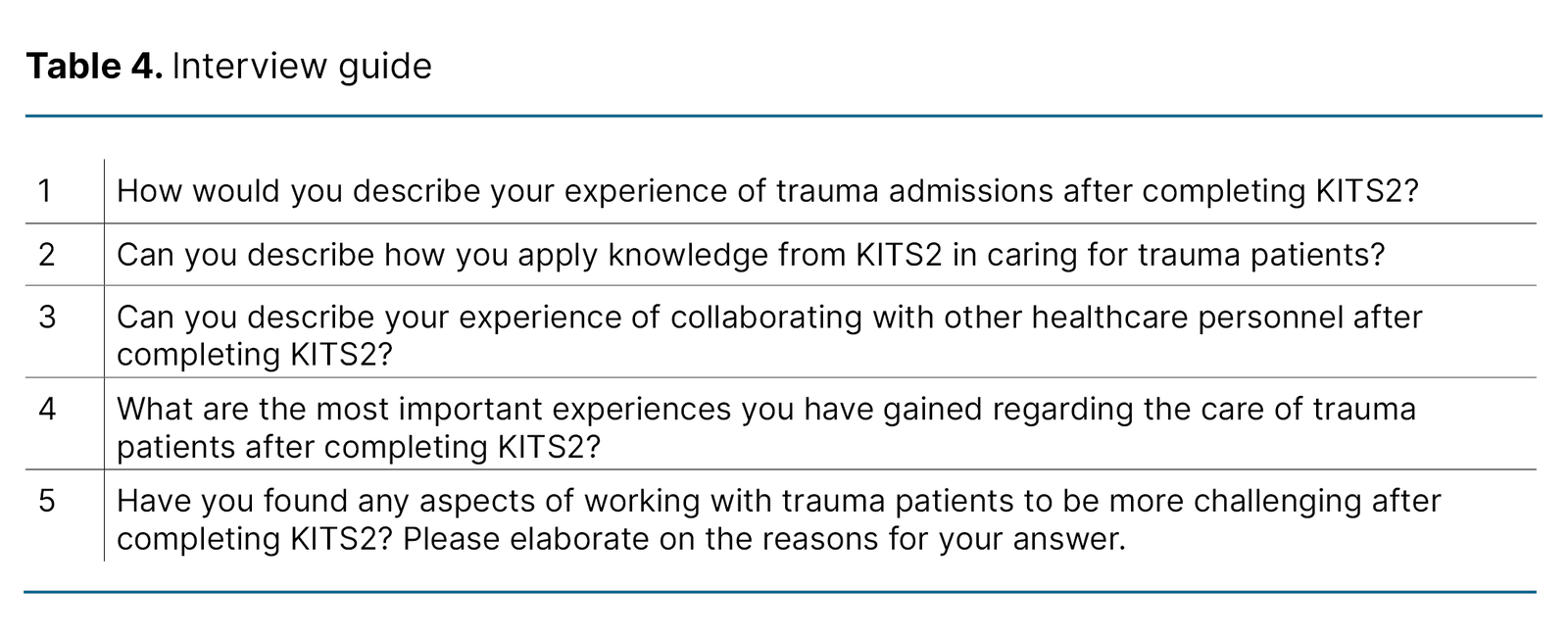
A semi-structured interview guide (Table 4) was developed for the study, informed by relevant literature and the content of KITS2 (5, 6, 18, 20). The guide was adjusted following pilot testing (20). Audio recordings were made of the interviews and transcribed verbatim. Field notes were taken throughout. The interviews produced 54 pages of transcribed text. Transcripts were not sent to participants for verification.
Study participants were anonymised using the letter S and numbers 1–13, and focus groups were labelled 1–3. The final part of the third focus group yielded no new insights. We therefore considered data saturation to have been reached (18).
Analysis
The data were analysed using Malterud’s four-step method for systematic text condensation (18). In the first step, we read the transcripts repeatedly to gain an overall impression of the material. In the second step, meaning units were identified and organised into code groups, which were developed through an iterative process. In the third and fourth steps, the content of the meaning units was condensed to capture their meaning, before the material was synthesised into a coherent analytical text (18).
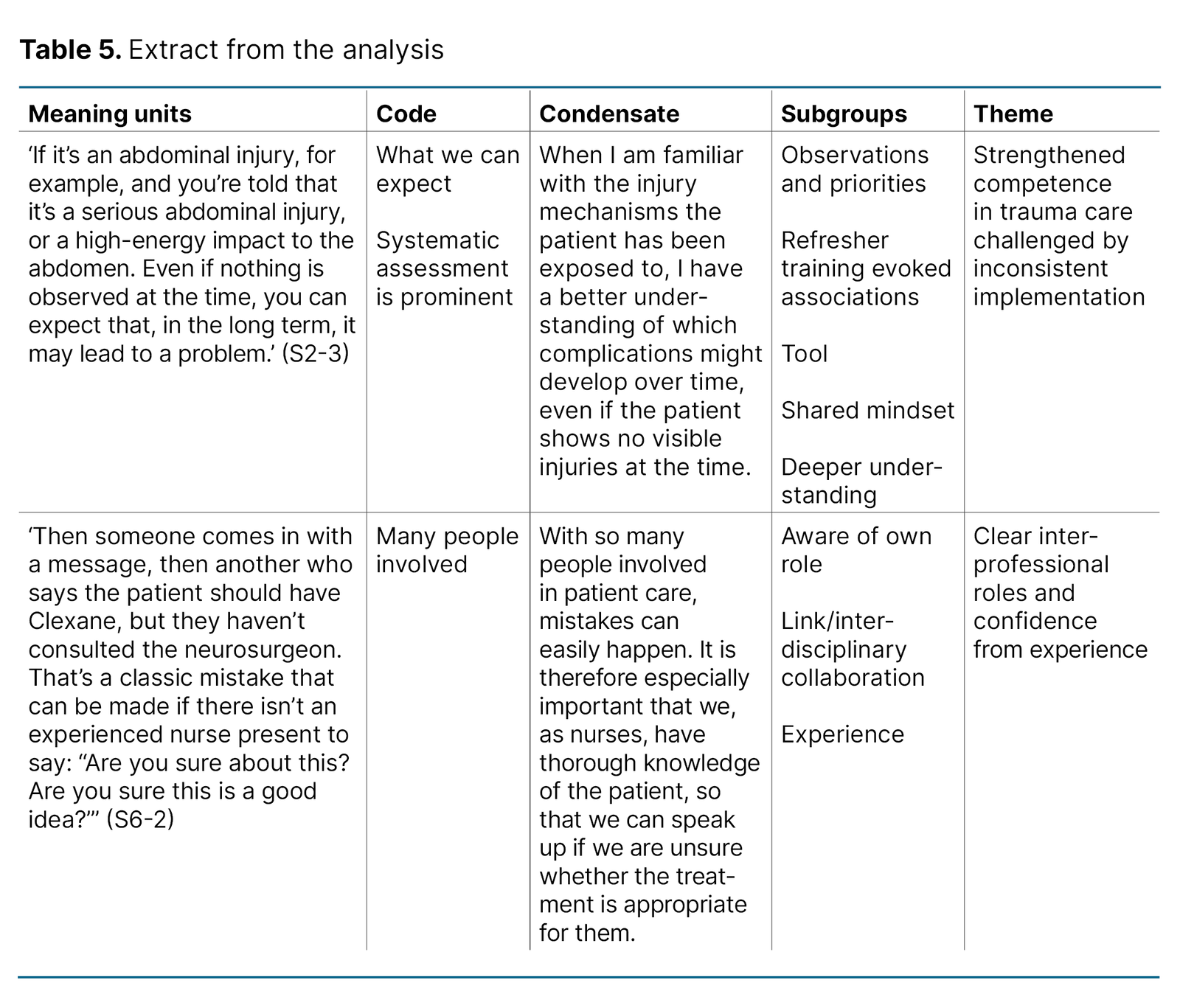
The first author performed the analysis, which was discussed throughout the process among the authors, and both the second and last authors brought extensive expertise in qualitative analysis. Three themes were developed. Table 5 presents an extract from the analysis.
Research ethics considerations
The study was reported to the Norwegian Centre for Research Data, now called Sikt – The Norwegian Agency for Shared Services in Education and Research (reference number 498468). Approval was then sought to interview potential participants at the trauma centre (case number 2023/4675) and at the acute hospital with trauma care facilities (reference number 2023/1728). Written informed consent was obtained from all participants (21).
Personal data were anonymised in the transcription process (22). Audio files and transcripts were stored on an approved research data storage platform and deleted at the end of the study. The first and last authors had access to the audio files during the storage period.
Results
Intensive care nurses’ experiences with KITS2 are presented under three themes: ‘Strengthened competence in trauma care challenged by inconsistent implementation’, ‘Clear interprofessional roles and confidence from experience’, and ‘Knowledge resource in patient care’.
Strengthened competence in trauma care challenged by inconsistent implementation
Intensive care nurses reported that KITS2 taught them about injury mechanisms, organ damage and the physiology of trauma patients. The course highlighted the consequences of injuries and complications throughout the course of treatment and was important for the nurses’ observations of trauma patients in the ICUs and high-dependency units.
The extent of injuries could initially be unclear. Abdominal trauma, for example, can cause severe, life-threatening bleeding even when no external injuries are visible:
‘Even when the patient comes through the trauma unit, you don’t really know if they’ve caught everything because things can change over time […] Even if the patient is stable now, they may not be stable in five minutes. You have to be constantly thinking, what’s happening, and why is it happening?’ (S2-3)
KITS2 helped to strengthen intensive care nurses’ understanding of the complexity of injury patterns, the body’s physiological response to trauma, and symptoms related to complications that could arise in later stages of the course of treatment: ‘After KITS2, I think I became even more aware of late complications and what I need to pay attention to. Care for this trauma patient is ongoing; issues can emerge afterwards.’ (S10-1)
The intensive care nurses described how KITS2 made it clear that patient assessments needed to be repeated systematically according to the ABCDE protocol. Trauma patients were described as unstable, and their condition could deteriorate rapidly.
By repeating assessments after the patient was admitted to the ICU or high-dependency unit, they could detect changes in the patient’s condition early and initiate appropriate treatment. Several participants noted that KITS2 clarified the connection between theory and practice:
‘There’s something about all the pieces falling into place. Patients who have developed compartment syndrome and things like that. It reinforces the theory, and it makes you a better intensive care nurse – I think that’s what KITS2 does. Because it refreshes your knowledge, something that we constantly need.’ (S10-1)
Although the course enhanced participants’ competence in trauma care, the extent to which systematic patient assessments were carried out in practice varied. It was therefore often random, depending on the individual nurse, whether these assessments were performed. Consequently, practice was unpredictable:
‘A KITS2 course doesn’t really help much if we don’t have a standardised departmental practice for how to do it.’ (S6-2)
The inconsistent implementation meant that knowledge from the course was not applied systematically, making the trauma admissions process confusing and fragmented at times. In uncertain situations involving many nurses, the absence of structure became particularly evident:
‘When there are 15 people in the room, messages can easily be missed, and it’s easy to feel stressed because you don’t have control of the situation – and that’s an absolutely terrible feeling.’ (S3-3)
This quote illustrates how the lack of clear structure could make intensive care nurses feel insecure in managing trauma patients. This finding highlights the need for competence development to be accompanied by clear guidelines.
Clear interprofessional roles and confidence from experience
Intensive care nurses reported that KITS2 helped clarify the responsibilities of the different professional groups involved in caring for trauma patients. Where role allocation had previously varied, it was now clear who was responsible for each task. This change made the organisation around trauma patients more structured. The nurses particularly emphasised the importance of the trauma team and the coordinating function of the trauma leaders.
Clarity at the different stages of the patient pathway made intensive care nurses more confident about what to expect from other professional groups. They felt reassured that the necessary assessments and interventions had been initiated when the patient arrived in the ICU. Previously, they had spent time checking this themselves:
‘The trauma team becomes more involved, it doesn’t get fragmented the way it tended to do when no one took responsibility, but the trauma leader is accountable and delegates tasks to everyone according to the extent of the injuries, and the necessary assessments are carried out without us having to call and chase them up.’ (S2-3)
KITS2 also helped the nurses develop a common understanding of how systematic patient assessments should be carried out. Consequently, the intensive care nurses’ teamwork was more effective during patient admissions: ‘You know more about how it should be done, and you know that others are thinking the same way as you, which makes it easier to carry out and feel that there is a system in place.’ (S11-1)
The intensive care nurses described trauma patients as a complex patient group with diverse needs and emphasised the importance of clinical experience when caring for these patients. Experienced nurses recognised patterns from previous cases and were able to guide patient care accordingly. This helped nurses feel more confident in managing acute and unpredictable situations:
‘Then someone comes in with a message, then another who says the patient should have Clexane, but they haven’t consulted the neurosurgeon. That’s a classic mistake that can be made if there isn’t an experienced nurse present to say: “Are you sure about this? Are you sure this is a good idea?”’ (S6-2)
Even intensive care nurses with many years of experience reported that KITS2 improved their ability to make independent decisions in complex situations and enabled them to assert their professional judgement more clearly in the interprofessional collaboration. This proved to be important for preventing complications, especially when injuries were not immediately visible:
‘When there are no obvious injuries – I had a classic example many years ago when the surgeon didn’t take us seriously. We kept giving more and more pain relief, and it turned out to be a serious bowel injury that wasn’t discovered until more than two days later. The patient went into septic shock, and I thought to myself, I will never let that happen again. We kept insisting, but no. When you become more knowledgeable and more confident in yourself, it gives you the courage to speak up even more and not give in.’ (S6-2)
Some nurses with extensive clinical experience found that KITS2 added little to their knowledge: ‘These were things that were already ingrained in my mind. After working with patients for many years, I felt there was very little new to learn.’ (S7-2)
Nevertheless, they felt reassured that the knowledge they had developed over many years as intensive care nurses was valuable: ‘That’s also good – to know that I already know quite a lot.’ (S13-1)
Some participants felt that KITS2 had too much focus on theory and would have liked a course with practical exercises:
‘I had high expectations for the course and was really looking forward to it. I thought it would focus much more on beside care of ICU patients, and that we would learn more from the observations we made in the patient’s room. Instead, it was just a lecture, really. A much more interactive format would have been better, like we had in KITS1.’ (S8-2)
Several participants emphasised the connection between KITS1 and KITS2, with KITS1 serving as a necessary foundation for KITS2.
Knowledge resource in patient care
The KITS2 course material was described as comprehensive and well-organised. The intensive care nurses used it actively as a source of reference and knowledge base in their work with trauma patients after completing the course. This knowledge resource was a useful tool when observing and assessing various injuries. The course material also provided updated information about equipment that could be used in the treatment of trauma patients:
‘I had a female patient with a severe pelvic fracture, and she had been fitted with a pelvic sling on arrival. I looked it up in the compendium we were given, just to understand the mechanism. To know what we could and couldn’t do, and what observations we needed to pay attention to regarding the pelvis.’ (S1-3)
Intensive care nurses shared the course material with colleagues and students who wanted to learn more about traumatology, as well as the observation and assessment of trauma patients in ICUs and high-dependency units. Many found the compendium useful for understanding other intensive care challenges and actively applied the knowledge from KITS2, including in the care of other ICU patients.
Discussion
This study shows that KITS2 helped improve intensive care nurses’ care of trauma patients. The course clarified roles and interdisciplinary responsibilities in patient care, but it also emerged that some units had well-established guidelines for trauma admissions, while others did not. Several intensive care nurses expressed a desire for a more practically oriented course, and the course material was used as a knowledge resource for trauma and intensive care patients.
Theoretical knowledge
The study highlights how KITS2 provides theoretical knowledge that gives intensive care nurses a greater understanding of the observations, assessments and technology needed to care for trauma patients. This finding is consistent with previous research showing that trauma nursing courses improve intensive care nurses’ knowledge about trauma patients (10–12, 15).
Although trauma patients and general intensive care patients share several characteristics, there are also differences that have implications for nursing care (2, 4, 5, 24). To observe and care for trauma patients effectively, intensive care nurses need theoretical knowledge of complications related to injuries and injury mechanisms in this patient group (4).
Our study shows that KITS2 helped strengthen experienced intensive care nurses’ understanding of the complex clinical picture of trauma patients. This finding supports the need for updated training for intensive care nurses who have responsibility for trauma patients and suggests that trauma nursing courses should be incorporated into the National Trauma Plan.
Practical exercises
Some of the intensive care nurses in the study expressed a desire for a more practically oriented trauma nursing course. Practical exercises improve hands-on skills and can make participants feel more confident in their abilities (12). However, theoretical knowledge on complications related to injuries and injury mechanisms is still necessary for effective and comprehensive care of trauma patients (4).
Learning through experience is important, but the combination of theoretical and practical skills is essential for safe, high-quality trauma care (24, 25).
Guidelines and national directives
The study indicates that ICUs and high-dependency units have, to varying degrees, implemented guidelines for the admission of trauma patients, or that existing guidelines are not followed in practice. Repeated systematic patient assessments according to the ABCDE protocol form the basis for treatment throughout the patient pathway, including the rehabilitation phase, and help to prevent late complications (3, 4).
If assessments are only carried out sporadically, patient safety may be compromised, and non-life-threatening injuries in trauma patients may not be detected until the rehabilitation stage (4). According to Section 16 of Norway’s Health Personnel Act, it is the organisation’s responsibility to ensure the implementation and monitoring of standardised guidelines for patient care at all stages of the course of treatment (25).
The National Trauma Plan and previous research have primarily focused on the initial phase of trauma care, which takes place in the emergency department (3, 10). This study demonstrates that there is also a need for knowledge about systematic assessments of trauma patients in ICUs and high-dependency units.
Strengths and limitations
The sample consisted of experienced intensive care nurses of varying ages and both sexes, and from two different hospitals. Because there were participants from both a trauma centre and an acute hospital with trauma care facilities, we gained insight into the diverse experiences in caring for trauma patients. Several of the experiences were similar. The findings may therefore be transferable to other hospitals that treat trauma patients. The participants had completed KITS2 at some point in the period 2017–2023.
As the participants attended the courses at different times, this may have impacted on their reflections and their ability to integrate and apply experiences from the course. The focus group format may have had an impact on participants’ openness and desire to discuss their experiences. Individual interviews could have provided different perspectives. The first author has personal experience in caring for trauma patients in intensive care units. In-depth knowledge of the field is an asset but it can also limit new insight and fresh perspectives due to so-called field blindness (18).
Conclusion
This study adds to the knowledge base about intensive care nurses’ experiences in caring for trauma patients in ICUs and high-dependency units following completion of KITS2. The study shows that KITS2 improves nurses’ observations and assessments of trauma patients and strengthens their understanding of interdisciplinary collaboration, while the course material helps maintain their knowledge after the course has concluded.
The findings may be of interest to intensive care nurses and managers in ICUs and high-dependency units, as well as course leaders and instructors in trauma nursing courses.
Effective trauma care requires optimal treatment at every stage of the trauma chain (3). This study indicates that advanced courses in trauma nursing could also benefit from including practical exercises. This finding should be considered in the further development of KITS2. The study highlights that the use of systematic patient assessments varies in trauma admissions in Norwegian ICUs and high-dependency units.
We recommend measures at the organisational level to ensure the best possible care for trauma patients throughout the entire course of treatment. Intensive care nurses play a central role in caring for trauma patients, and their responsibilities should be covered in the National Trauma Plan. As part of the effort to strengthen this field, KITS2 should be implemented in all ICUs and high-dependency units that care for trauma patients.
The authors declare no conflicts of interest.
Open access CC BY 4.0
The Study's Contribution of New Knowledge


Comments