Clinical supervisors’ experiences of guiding nursing students in the Physical Examination and Health Assessment methodology
Summary
Background: Developments in health care mean that the nursing role must adapt and new competencies must be developed to meet patients’ needs. The Physical Examination and Health Assessment (PEHA) method, which includes skills in inspection, palpation, percussion and auscultation, equips nurses to perform thorough, structured assessments of patients’ conditions. The method also strengthens nursing students’ ability to integrate theory with practice, enhances their clinical skills, and contributes to patient safety. Although PEHA has been widely researched in nursing education and clinical practice, research on clinical supervisors’ experiences of guiding nursing students in its use remains limited.
Objective: To explore clinical supervisors’ experiences with PEHA in clinical practice and in guiding nursing students in its use. The study also sought to explore how these experiences shape the supervisory role in clinical practice.
Method: A qualitative, exploratory design was employed. Three focus group interviews were conducted with nine nurses (three per group) at a large hospital in the county of Vestland in Norway. Data were analysed thematically using Braun and Clarke’s method.
Results: The study found that supervision in PEHA is characterised by a tension between clinical and pedagogical responsibilities. Many clinical supervisors are themselves in the process of learning while simultaneously being expected to guide nursing students, which can lead to variation in the quality of supervision. Supervisors reported unclear professional boundaries and uncertainty as to whether PEHA is a natural component of the nursing role. When combined with limited multi-professional integration and low demand from doctors, this contributes to a reduced sense of ownership of the method among nurses. Participants called for clearer expectations from both educational institutions and the field of practice regarding nursing students’ use of PEHA, as well as better training and support for supervisors to improve students’ learning outcomes.
Conclusion: Clinical supervision in PEHA is characterised by an unclear division of responsibilities between clinical duties and pedagogical oversight of nursing students. Uncertainty and blurred professional boundaries can weaken the use of PEHA in student supervision. Establishing clearer, mutually agreed expectations between clinical supervisors and nursing students, multi-professional collaboration, and support for supervisors could enhance both the supervisory role and students’ learning in clinical practice.
Cite the article
Smith-Strøm H, Svellingen A, Gissum K. Clinical supervisors’ experiences of guiding nursing students in the Physical Examination and Health Assessment methodology. Sykepleien Forskning. 2025;20(103756):e-103756. DOI: 10.4220/Sykepleienf.2025.103756en
Introduction
Health care is continuously evolving, requiring the nursing role to be regularly adapted and developed (1). These changes increase the demands on nurses’ competencies with a view to them meeting patients’ care needs both now and in the future (2).
Nursing involves delivering person-centred, professional, high-quality care. The ultimate goal is to ensure patient safety through thorough and carefully considered clinical decision-making processes (3, 4). The Physical Examination and Health Assessment (PEHA) method provides nurses with an important tool for performing a thorough and structured clinical assessment (5, 6).
PEHA encompasses four core examination skills: inspection, palpation, percussion and auscultation. These skills are essential for identifying early signs of illness or deterioration, thereby helping to prevent complications and improve patient outcomes (5, 7).
The purpose of PEHA in nursing education is to enhance students’ ability to perform independent and informed clinical assessments, thereby improving patient safety. PEHA also supports students in applying theory to practice, thereby helping them develop the skills to prioritise, assess and evaluate patients’ care needs safely and effectively (5).
PEHA was first introduced into nursing education in Norway in 2013 (5). The method underpins the study programme’s objective of providing clinical placements that meet professional standards, build on up-to-date knowledge and competence, and foster respect, independent judgement, and the ability to make independent judgements, prioritise care and critically evaluate the nursing care and treatment (8, 9).
The Norwegian Regulation on National Guidelines for Nursing Education requires that clinical placements are organised in a collaboration between the educational institution and the field of practice (9). Additionally, both Universities Norway (UHR) and the Norwegian Agency for Quality Assurance in Education (Nokut) have published reports highlighting the importance of quality in clinical practice, student supervision and quality assurance in clinical placements (10, 11). The quality of clinical placements is shaped by the supervisor’s role, the students’ learning and skill development, and the structure and organisation of the learning environment (12).
Introducing PEHA in nursing education in Norway has been challenging, partly because the Norwegian Regulation on National Guidelines for Nursing Education allows for varying interpretations of the expected level of knowledge on PEHA (9). Although the regulation does not explicitly mention PEHA, it establishes overarching requirements for students’ clinical assessment competence. For example, students are required to ‘carry out independent, systematic clinical assessments, priority-setting and decision-making’ (9, section 2) and to ‘apply clinical knowledge of health and disease in order to systematically observe, assess, decide, implement and document appropriate nursing interventions’ (9, section 5a).
These broad formulations allow for divergent interpretations, potentially resulting in inconsistent implementation and use of PEHA across educational institutions and the field of practice. Furthermore, a literature review from 2021 identifies several other barriers to the implementation of PEHA (13). These include students’ individual challenges, organisational factors in nursing education and constraints related to clinical practice.
The review emphasises the need for more structured and competence-based education in both academic and clinical settings in order to facilitate use of PEHA. Research also suggests that students often experience a gap between theory and practice, and that clinical supervisors lack sufficient knowledge in certain aspects of PEHA (14).
One possible explanation is that the study programme covers too many skills, making it difficult to prioritise the most relevant ones (15). In addition, the skills of auscultation and percussion are reported to be underutilised in clinical practice, suggesting a need for more targeted training (15).
These findings are consistent with the study by Tan et al. (16), which highlights the importance of focussing on depth rather than breadth when teaching PEHA. The study further highlights the key role of clinical supervisors in supporting students to acquire, apply and further develop PEHA skills during clinical placement.
Previous research examining clinical supervisors’ experiences in their supervisory role shows that the quality of clinical placements is closely linked to supervisors’ competence. High-quality supervision and strong supervisory–student relationships enhance student satisfaction and impact on students’ attitudes to the profession. Meanwhile, insufficient supervisory competence can lead to poorer learning outcomes among students (17, 18).
PEHA may be considered a relatively new nursing skill, and it has only been introduced into nursing education in recent years. While the primary aim has been to train students in the method, clinical supervisors have not, to our knowledge, been systematically trained in this. Although there is extensive research on the use of the method in nursing education and clinical practice, there is insufficient knowledge on clinical supervisors’ experiences of guiding nursing students in the use of PEHA.
Objective of the study
The objective of this study was to gain insight into clinical supervisors’ experiences of using PEHA in clinical practice and in guiding nursing students. The study also sought to explore how these experiences shape the supervisory role in clinical practice.
Method
Design
The study employed a qualitative, exploratory design (19) using focus group interviews with nurses who supervise students in clinical placements. The study was conducted and reported in accordance with the COREQ checklist (20). It was a collaboration between VID Specialized University and two departments at a large hospital in the Norwegian county of Vestland that provide supervision for VID students in clinical placements.
Sample
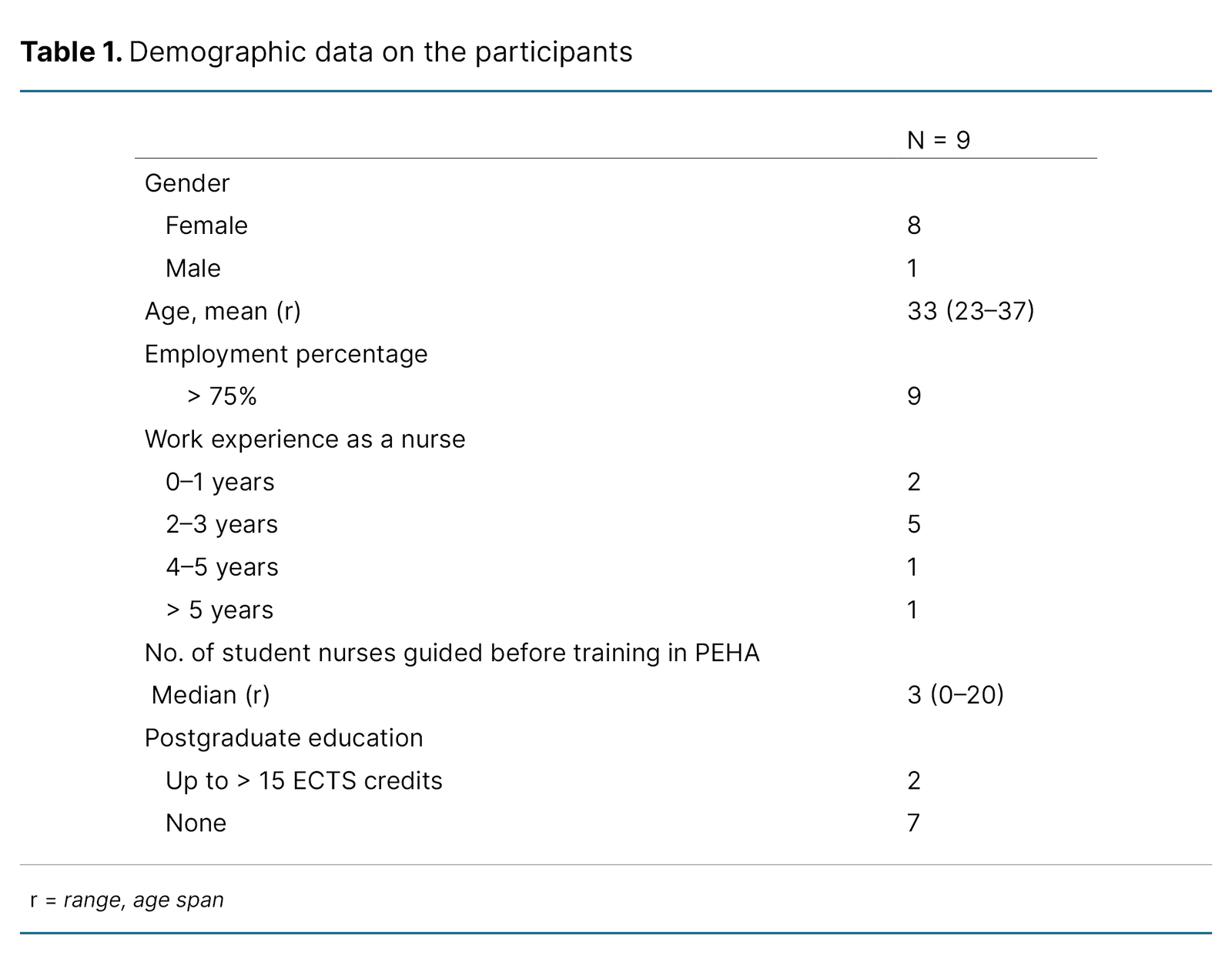
All nurses in the two departments who had completed training in the PEHA method were invited to participate in the study. A total of 20 nurses met the eligibility criteria, but seven had left their positions before recruitment began. The assistant head nurse sent the invitation to the remaining eligible nurses, and those interested were subsequently contacted to provide further information and obtain consent.
Nine nurses from two departments agreed to participate. Four declined: one due to illness and the others due to workload pressures. Inclusion criteria required participants to have completed PEHA training and have responsibility for supervising nursing students in clinical placements.
The PEHA training course included a brief introduction to the method, followed by a theoretical overview of the four clinical examination techniques: inspection, palpation, percussion and auscultation, applied to the heart, lungs, abdomen and central nervous system. This was followed by group-based practical training on using the method in relation to the four organ systems.
The training course was designed to ensure that nurses acting as clinical supervisors for nursing students acquired knowledge and skills in PEHA that aligned with the students’ learning objectives for the clinical placement. It did not focus on supervision pedagogy or student supervision, which are addressed through other collaborative forums involving the field of practice and VID.
Data collection
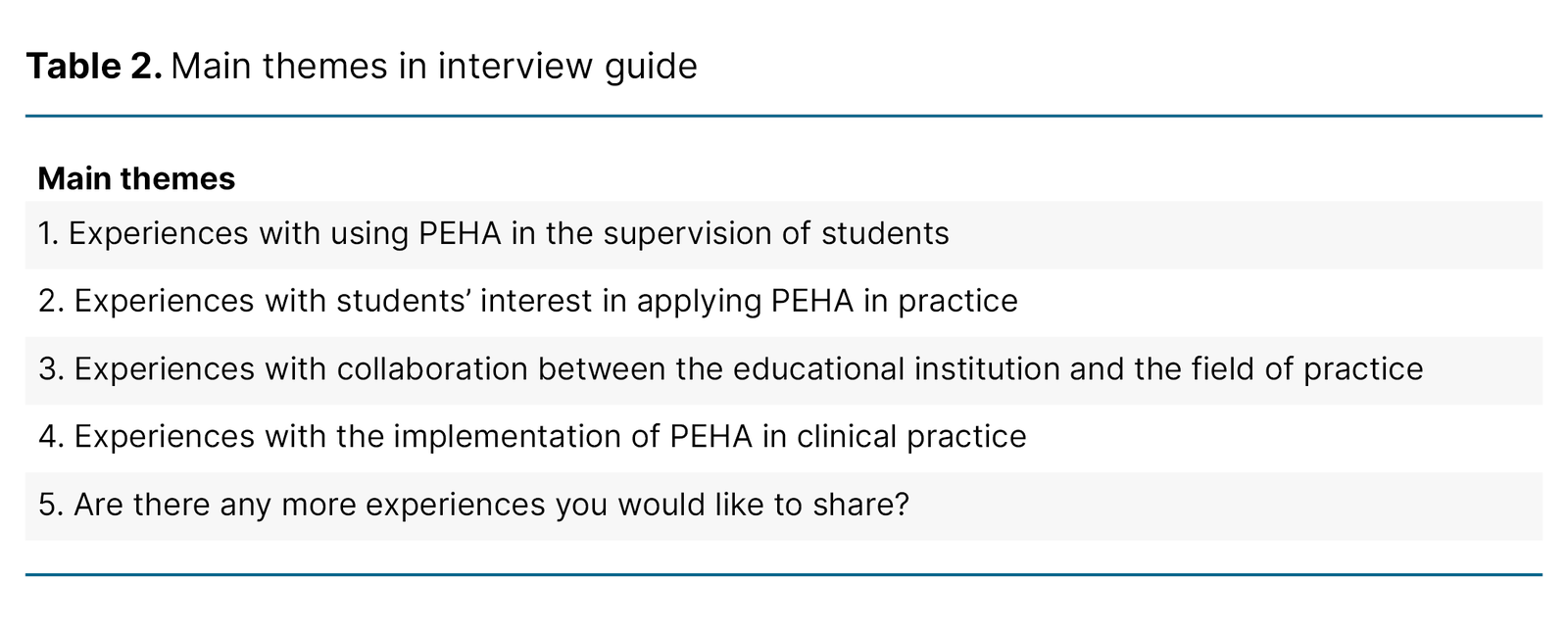
We devised a semi-structured interview guide with five overarching themes, based on the study’s research question and previous literature. Three focus group interviews, each including three participants, were conducted between September 2022 and November 2023 at the participants’ workplaces (Table 2).
Interviews lasted 49 to 60 minutes each. The atmosphere was calm and undisturbed, and participants shared their experiences openly. In all interviews, the first author served as moderator, with the second and last authors acting as co-moderators.
Analysis
The first author audio-recorded the interviews and transcribed them verbatim, while simultaneously taking field notes to capture immediate impressions. The data were analysed using Braun and Clarke’s six-step reflexive thematic analysis (21).
All authors first read the transcripts numerous times to familiarise themselves with the content, highlighting words and passages of particular significance. In step 2, each interview was coded line by line, assigning preliminary codes to statements relevant to the research questions.
In step 3, codes were sorted into preliminary themes: first within each interview, then across the entire dataset, allowing subthemes and overarching patterns to emerge. Step 4 involved a critical review of the themes at two levels: (1) ensuring that the codes within each theme made sense and were logically connected, and (2) confirming that each theme collectively represented a comprehensive picture of the dataset. The clarity and accuracy of the overall ‘thematic map’ were also evaluated.
In step 5, the themes were refined and named to clearly convey their core meaning and the aspects of participants’ experiences they reflected. This process resulted in two overarching themes with associated subthemes. Finally, we drew up a report in which each theme was illustrated with representative quotes supporting the findings (Table 3).

Ethical considerations
The project was reported to the Norwegian Centre for Research Data, now known as Sikt – the Norwegian Agency for Shared Services in Education and Research (reference number 629512). Participants received both oral and written information about the content and objective of the study before consenting to participate. They were assured of anonymity, informed that participation was voluntary, and advised that they could withdraw at any time before their data were included in the analysis.
Results
The participants in the study had diverse experiences, providing a nuanced view of PEHA supervision and the challenges associated with the method. The analysis identified two main themes: (1) ‘Clinical supervision at the intersection of clinical work and educational responsibility’, with the subthemes Supervising while learning and The challenge of professional boundaries, and (2) ‘The importance of collaboration for quality in clinical supervision’, with the subthemes Unclear expectations and responsibilities and Supervisors’ need for support and follow-up.
Clinical supervision at the intersection of clinical work and educational responsibility
Supervising while learning
Several participants described supervising students in PEHA while still being in the process of learning the method themselves. They found it challenging to appear confident and competent when they were uncertain about the method. Some noted that it was difficult to know what to expect from students while they themselves were still learning. However, many found that explaining and demonstrating PEHA during supervision enhanced their own learning. One participant expressed it as follows: ‘When I explain it to the student, I understand it better myself’, and several noted that supervising students gradually increased their own confidence.
In contrast, some participants felt confident using PEHA and actively applied the method both to assess patients and to guide students. They described PEHA as particularly useful in situations with high NEWS scores, and explained how systematic observations helped identify the causes of patients’ conditions. During supervision, they encouraged students to make independent observations before discussing the patient’s case with them.
Participants asked questions such as, ‘What did you observe? Have you palpated, percussed and auscultated the abdomen? What did you find? What are you unsure about?’ to strengthen students’ understanding of and awareness in using PEHA in clinical practice. PEHA thus served not only as a tool for clinical assessment but also as a foundation for clinical supervision and a key instrument for learning.
The challenge of professional boundaries
The participants recognised the value of PEHA in clinical practice and reported that the method enhanced their clinical assessment competence. However, they were uncertain whether PEHA is a natural component of the nurse’s remit. Some questioned whether PEHA falls within the nursing role or whether it should instead be the doctor’s responsibility. As one informant said: ‘I tend to think it is the doctor who does it. We do observe, but not in such a structured way.’
They said that the uncertainty centred on role allocation – specifically, whether PEHA is the responsibility of nurses or doctors. Such role ambiguity often led to PEHA being deprioritised in the busy clinical environment, potentially limiting its adoption as an integral part of nursing practice. However, several participants expressed a desire to further develop their competence and to apply PEHA more systematically. This may indicate that attitudes and sense of ownership have a bearing on whether it is used in practice.
The participants further emphasised that practices need to be changed in order for PEHA to become an integral and established component of nursing care. Nonetheless, they found it challenging that PEHA was seldom discussed with doctors within the department, and that the extent to which doctors required this competence varied. One participant described this as follows: ‘PEHA not only provides me with important information, it’s also helpful when I need to contact the doctors. It’s not always well received.’
The participants called for closer collaboration with doctors to strengthen their own competence and to apply PEHA in clinical practice, in line with medical students’ training. They reported that multi-professional training together with doctors was often deprioritised, thereby limiting nurses’ opportunities for professional development in the use of PEHA. Some participants noted that the lack of multi-professional integration of PEHA made it challenging to actively involve students in the method. As one nurse explained: ‘When it’s not part of the routine collaboration with doctors, it’s difficult to show students that this is something we actually use in clinical practice.’
Several participants gave the impression that their uncertainty stemmed from the lack of integration of PEHA in both clinical practice and the multi-professional team. Consequently, the method was frequently downplayed in clinical supervision.
The importance of collaboration for quality in clinical supervision
Unclear expectations and responsibilities
Several participants reported that the educational institution did not articulate clear expectations or specify required coursework related to PEHA in the course plan. They emphasised that when PEHA was not covered in expectation-setting meetings and mid-way assessments, it was difficult for both students and clinical supervisors to know what should be prioritised in the supervision.
To strengthen the focus on PEHA in nursing education, several participants suggested introducing coursework requirements. Such measures would enable both students and supervisors to maintain an emphasis on PEHA throughout the entire clinical placement. As one clinical supervisor explained: ‘Raising PEHA during expectation-setting meetings and mid-way assessments is a step in the right direction, as it establishes a clear learning objective for the clinical placement, which is likely to increase the use of PEHA.’
Some participants also highlighted how students’ learning of PEHA largely depends on the degree of responsibility they assume and the effort they invest. Students who demonstrated initiative and actively sought clarification received more constructive supervision and developed a better understanding of the method. One supervisor remarked: ‘Those who ask questions and want to practise clearly gain much more from it.’
Conversely, the participants also reported that limited student engagement often resulted in PEHA being deprioritised in the supervision. Some attributed this to the absence of clear requirements from the educational institution. They found that when there were no clear learning objectives for PEHA, it was difficult to motivate students. As one informant noted: ‘If there is no requirement or clear learning objective, I think students assume it is not that important.’
The participants therefore called for clearer expectations from the educational institution in order to ensure more structured training.
Supervisors’ need for support and follow-up
The participants called for additional follow-up training in PEHA by the educational institution in order to improve their confidence in supervising students. They noted that a single day of training was insufficient, despite the course being informative. They felt it was important to have PEHA refresher courses, especially using simulations, as a means of strengthening their skills and self-confidence.
The need for ongoing professional development was also linked to the supervisory role. Several participants explained that when they felt uncertain themselves, they were more reluctant to guide students in PEHA. They noted that systematic competence development among supervisors is crucial for ensuring that students receive a consistent and robust introduction to PEHA.
Discussion
This study explores the challenges faced by clinical supervisors when guiding students in PEHA during clinical practice. Two main themes emerged: (1) Clinical supervision at the intersection of clinical work and educational responsibility, and (2) The importance of collaboration for quality in clinical supervision.
Reciprocal learning and professional development
PEHA was applied in different ways in the supervision of students in our study. The findings suggest that supervising students in PEHA while the supervisors themselves are in a learning process can be challenging but also helpful for guiding students. Several participants, however, found it difficult to appear competent and supportive when they themselves felt uncertain about the method. As previous research shows, this uncertainty can lead to the method being downplayed in practice, potentially leading to poorer learning outcomes for students (22).
However, several participants reported that their own learning was enhanced when they had to explain and demonstrate PEHA to students. This aligns with Schön’s concept of reflection-in-action, whereby professional knowledge is developed through practice and reflection (23). Interaction between student and supervisor can thus stimulate reflection and discussion. Research also indicates that teaching others can make supervisors more reflective and conscious of their own role (24, 25).
Consequently, the supervision setting can serve as a reciprocal learning arena in which both students and supervisors develop clinical assessment competence. PEHA represents a new assessment tool that facilitates this learning while simultaneously challenging traditional expectations of the supervisory role. Recognising uncertainty may feel uncomfortable and could threaten supervisors’ professional identity, potentially limiting learning opportunities. Adopting an open and reflective supervisory approach, in which uncertainty is acknowledged as part of professional growth, can strengthen the supervisor–student relationship as well as learning outcomes.
The findings also show that several participants placed a high value on using PEHA and actively integrated the method and associated skills into patient care and student supervision. Participants who incorporated PEHA into their supervision challenged students to master both technical skills and the interpretation of findings, with the aim of enhancing students’ clinical assessment competence. This is consistent with previous research (6).
PEHA therefore serves as a tool for clinical assessment, a platform for clinical supervision and support for students’ professional development. This finding is reinforced by research showing that supervisors’ self-assurance and skills impact on the learning environment, and that students’ proficiency with clinical tools strengthens their development of clinical reasoning skills (15, 25).
These findings are particularly significant because, when supervisors’ competence in PEHA varies, students may receive differing levels of instruction depending on which supervisor they are assigned. This challenges the principle of consistent learning outcomes in clinical placement and highlights the need for a common clinical framework and continual updating of supervisors’ skills.
It is also important to emphasise that students bear part of the responsibility for their own learning. Participants found that students’ learning outcomes were closely linked to their motivation and effort. Students who showed initiative and asked questions received more constructive guidance, whereas PEHA was often deprioritised for students who were less engaged, which is in line with previous research (26).
Need for collaboration and training
Another interesting finding was the participants’ agreement that PEHA should be an integral part of nursing practice in student supervision, even though it is applied differently across clinical settings. Introducing PEHA in clinical placement requires close collaboration between educational institutions and the field of practice, as found in previous research (5, 14).
This collaboration should involve a coordinated effort to clarify students’ expectations and required coursework. Clear guidelines should also be established for nurses acting as supervisors. This approach can foster a shared understanding of students’ expectations at the start of their clinical placement.
Investing in the training of nurses who supervise students in PEHA is also crucial to ensuring effective implementation. Strengthening the collaboration between educational institutions and the field of practice is a key component in this effort, as effective supervision requires clear communication and shared expectations (27).
Joint appointments spanning the educational institution and the clinical setting may further promote continuity and understanding. However, these require clearly defined roles and careful resource management (28). In this context, educational institutions must adopt an active and supportive role.
Professional boundaries as a barrier in PEHA and the nurses’ role in the team
The findings indicate that professional boundaries can impede the implementation of PEHA and prevent it from being a natural component of the supervision. Several participants expressed uncertainty about whether PEHA was within the nurse’s remit or was primarily the responsibility of the doctor. This aligns with theories of professional boundaries, which suggest that professions protect their domains to maintain status and control (29).
When it is unclear whether PEHA is part of the nursing role, the motivation and self-confidence of clinical supervisors may be undermined. Consequently, the method may be downplayed during supervision, limiting students’ opportunities to develop clinical skills and assessment competence.
To successfully strengthen PEHA in clinical practice, it is crucial to break down professional boundaries and foster a shared understanding between doctors and nurses. The findings indicate that few doctors in the study sought this competence from nurses, and PEHA was rarely discussed in a multi-professional context. This can undermine the legitimacy of the method and make it more difficult for clinical supervisors to integrate PEHA as a natural component of student supervision. Developing more advanced competence among nurses could also enhance their standing within the multi-professional team (30, 31).
Research shows that a deeper understanding of other professions’ contributions to patient care strengthens multi-professional collaboration (32). Nurses often have a central and coordinating role within the team, and PEHA can reinforce this by providing a shared language and a common framework for systematic clinical assessment. This, in turn, can improve communication with doctors and other healthcare personnel (6).
PEHA therefore serves as a tool that both clarifies the nurse’s contribution and strengthens the multi-professional collaboration. For students, training in PEHA provides insight into how nurses can take an active role within the team and contribute to comprehensive patient care.
Strengths and limitations of the study
The dataset was rich, despite the number of informants being lower than is generally considered ideal for a focus group study (33). The participants varied in age, professional background and experience in supervising students, providing a broad base of experience that made the findings both relevant and transferable to the field of practice.
Data were collected over a period of more than a year due to the pandemic, which resulted in high nurse turnover within the department. Consequently, several new PEHA courses had to be held, and the group of participants comprised nurses with differing levels of experience with the method. The extended data collection period may also have resulted in organisational changes within the departments impacting on the participants’ experiences, which in turn may have had a bearing on the study’s findings.
Focus group interviews foster interaction between participants and enable an in-depth exploration of their experiences. The study examined clinical supervisors’ experiences of student supervision in PEHA, with an emphasis on their perspectives and reflections (34). As the supervisors worked shifts, it was more practical to hold focus group interviews. While individual interviews might have yielded more detailed or sensitive information, focus group interviews were, on balance, deemed the most appropriate method (34).
The aim of the study was to improve understanding of clinical supervisors’ experiences in guiding students in PEHA. All the authors are experienced PEHA supervisors, which was helpful as it meant we could ask relevant questions, but it also carries the risk that our preunderstandings could limit unexpected insights. We remained mindful of this throughout the research process and actively sought to ensure our preunderstandings did not influence the findings.
Conclusion
The findings show that supervision in PEHA is characterised by a tension between clinical and pedagogical responsibilities. This can create uncertainty and lead to variation in supervisory practices. However, supervisors who are confident using the method foster more active use of PEHA, both in clinical assessment and student supervision.
We also found that unclear professional boundaries and a lack of multi-professional integration can undermine nurses’ ownership of PEHA, which in turn may limit students’ opportunities to learn the method. This issue is further compounded when doctors have no demand for PEHA competence and when opportunities for multi-professional training are limited.
To enhance student learning, the collaboration between educational institutions and the field of practice should clarify expectations regarding students’ use of PEHA. Supervisors should be given training and support. Moreover, promoting multi-professional collaboration, with both doctors and nurses participating, is crucial for developing a shared understanding that strengthens the nurse’s role in clinical practice.
Future research should explore how clinical supervisors’ own learning processes impact on student learning, and how multi-professional collaboration can help establish PEHA as a natural component of both the supervisory role and nurses’ clinical practice.
The authors declare no conflicts of interest.
Open access CC BY 4.0
The Study's Contribution of New Knowledge

Comments